Short answer: a game music partnership works when the artist is chosen for a specific business job in a named market, the audience and repertoire fit are credible, the rights are executable, and the project leaves a durable asset after launch.
The brief often begins with a familiar sentence: “We need an Asian artist.”
It sounds specific. It actually hides five unresolved decisions. Which business outcome? Which market? Which audience? Which rights path? What should remain when the campaign ends?
That is how teams end up debating fame before function. The artist comes second. The operating logic comes first.
1. DEFINE
THE JOB.
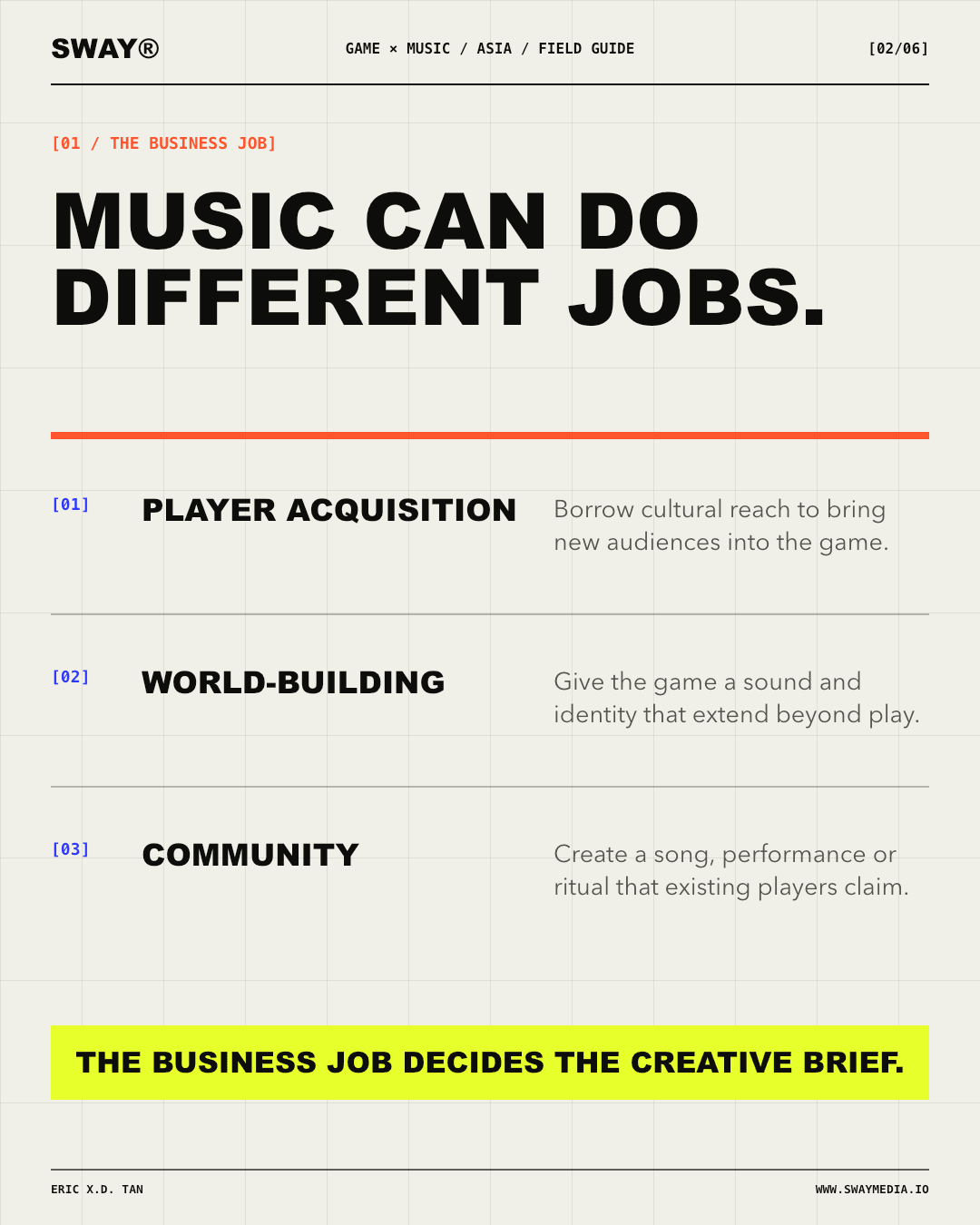
Music can acquire players, give a game world a sonic identity, or turn an esports community into a cultural community. Those are different jobs with different creative choices and different measures of success.
- Player acquisition: reach people who do not already know the game and give them a reason to enter.
- World-building: make the game feel more distinctive, memorable and emotionally legible.
- Community identity: give existing players a song, performance or ritual that feels like it belongs to them.
A large artist can create reach. That does not automatically create player relevance. An original song can build IP. That does not automatically deliver acquisition. The objective decides the artist, the format, the distribution plan and the KPI.
2. NAME
THE MARKET.
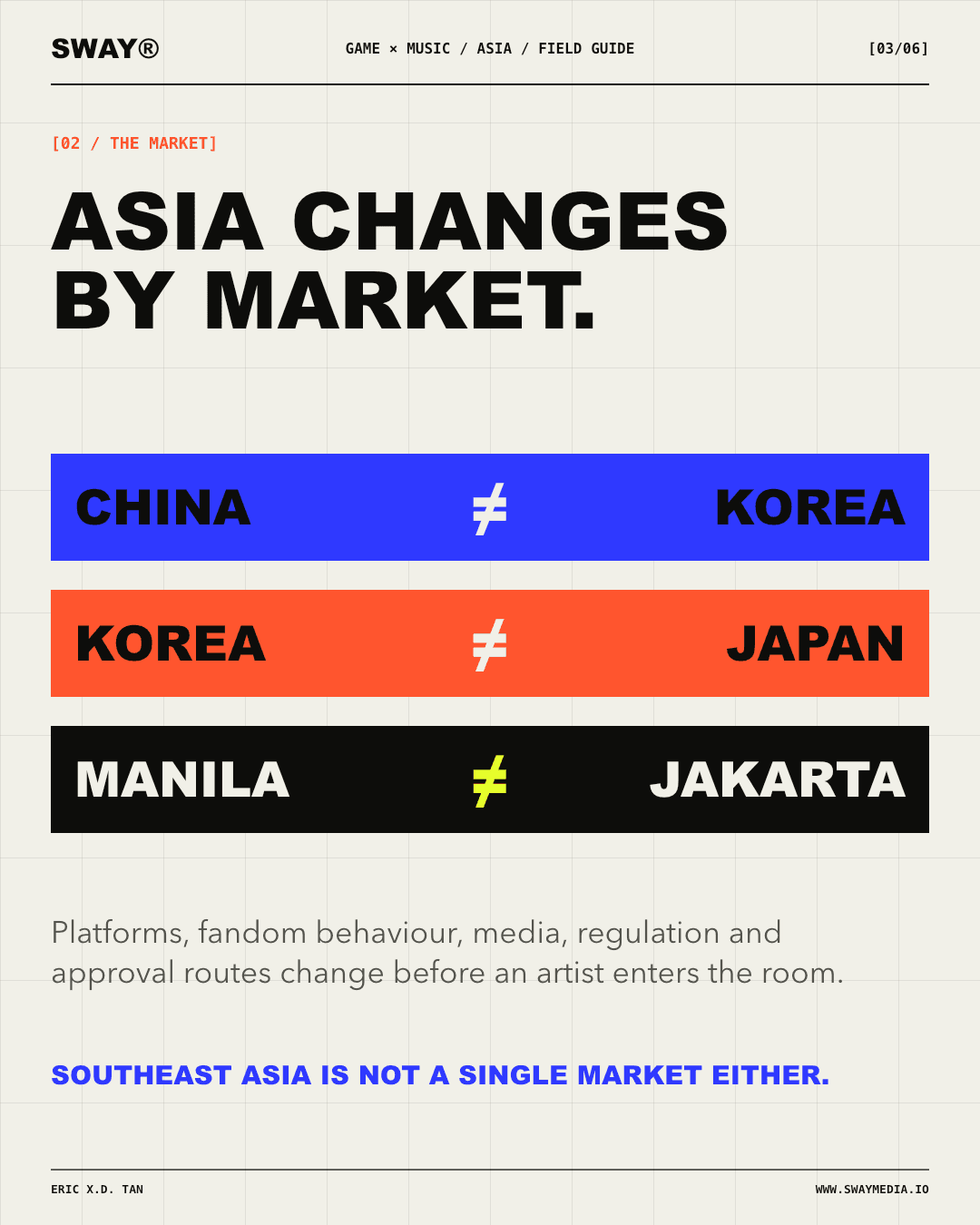
“Asia” is not a market plan. China, Japan and Korea have distinct music platforms, repertoire systems, fandom behavior, licensing practices and approval environments.
Southeast Asia is not one market either. A strategy built for Manila cannot simply be translated for Jakarta, Bangkok or Ho Chi Minh City. Language matters, but so do creator ecosystems, payment behavior, esports culture and the way fandom organizes online and offline.
MARKET FIT
COMES BEFORE
STAR POWER.
K-pop may be the right answer for a particular audience and objective. It is not a substitute for deciding where the project needs to work and why.
3. GIVE FIT
A SPECIFIC JOB.
Artist fit is not a vague feeling. It is the credible connection between an artist, a game, a piece of music and a defined audience.
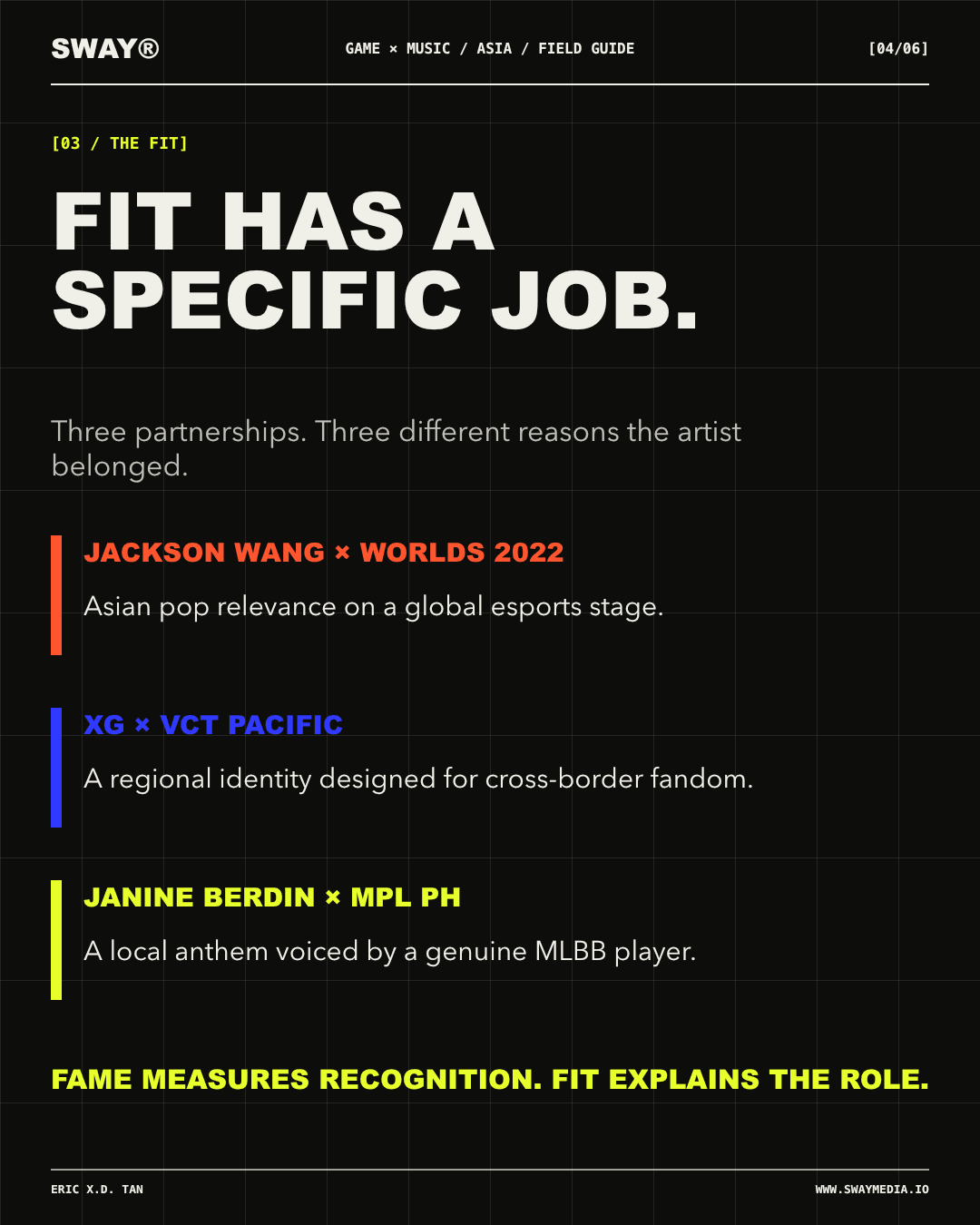
For Jackson Wang and FIRE TO THE FUSE, Eric used his regional music experience and relationships as Head of Music, APAC at Riot Games to help bring Jackson into the Worlds 2022 program. The artist brought authentic relevance for Asian players while entering a global esports moment through an original League of Legends music property.
For XG and UNDEFEATED, the job was different. The song needed confidence, cross-market reach and a credible relationship with VCT Pacific. XG's identity matched the competitive message and the regional ambition of the league.
MOONTON Games, Universal Music Group Philippines and Janine Berdin offer another model. Berdin was not only a recognizable Filipino artist. She was also a genuine Mobile Legends: Bang Bang player. That made the official MPL Philippines theme song feel connected to the community it was built to serve.
4. MAP
THE AUTHORITY.
A culturally strong idea can still fail if no one owns the authority to say yes. Before the creative promise grows, map the rights and approvals that determine whether the concept can travel.
- Master and publishing rights
- Name, image and likeness
- Game integration and in-client use
- Live performance and broadcast rights
- Territory, term and exclusivity
- Artist, label, publisher and game approvals
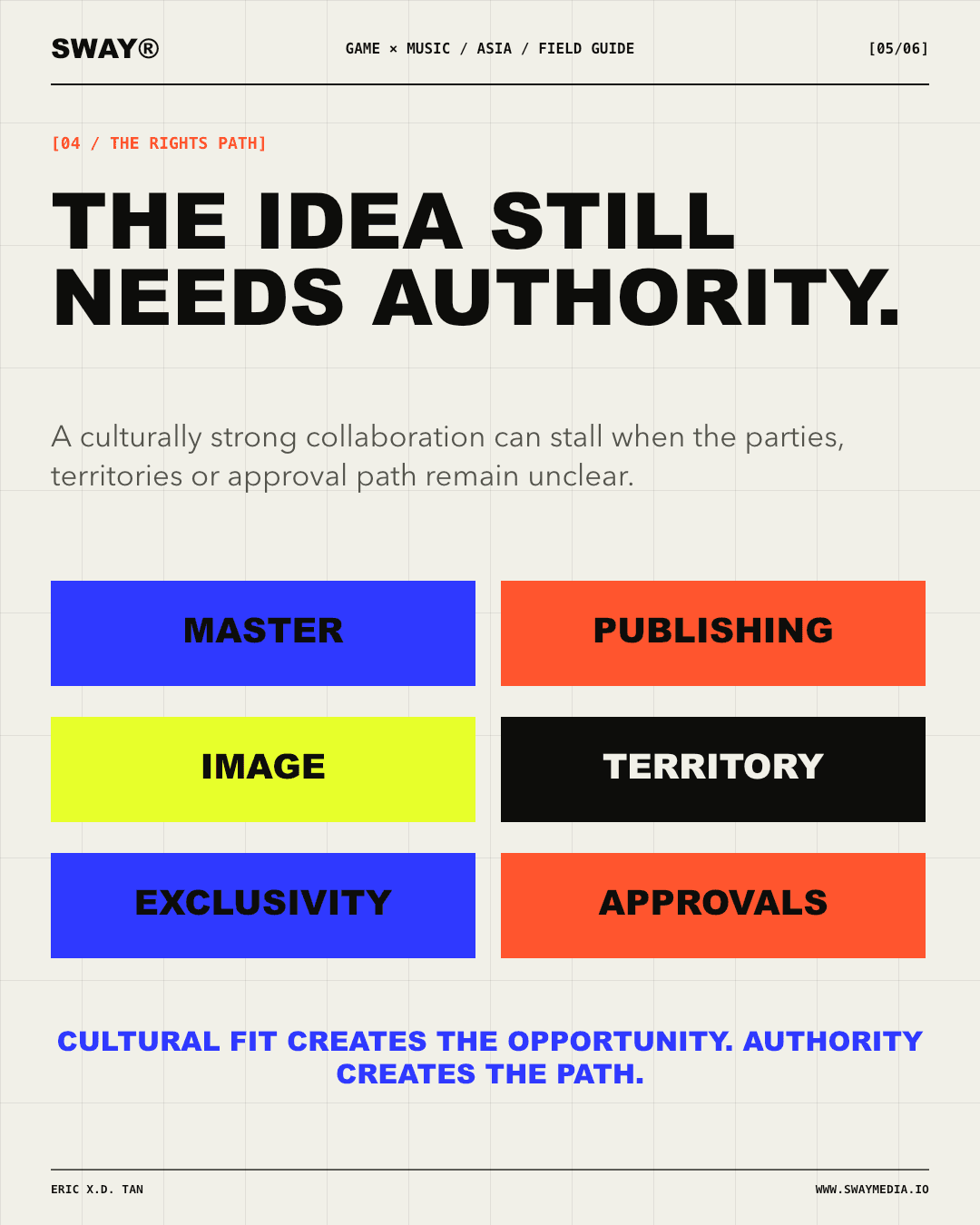
The earlier this map is clear, the more ambitious the creative can become. The later it appears, the more likely the strongest idea gets reduced to the rights everyone can secure quickly.
5. BUILD
WHAT REMAINS.
A launch is a moment. A durable asset gives the game something it can keep using, growing or learning from.
- An original song that can travel across platforms and events
- A recurring live format that the community anticipates
- In-game content connected to the music property
- A fictional artist or music world the publisher can develop
- A community ritual that players choose to repeat
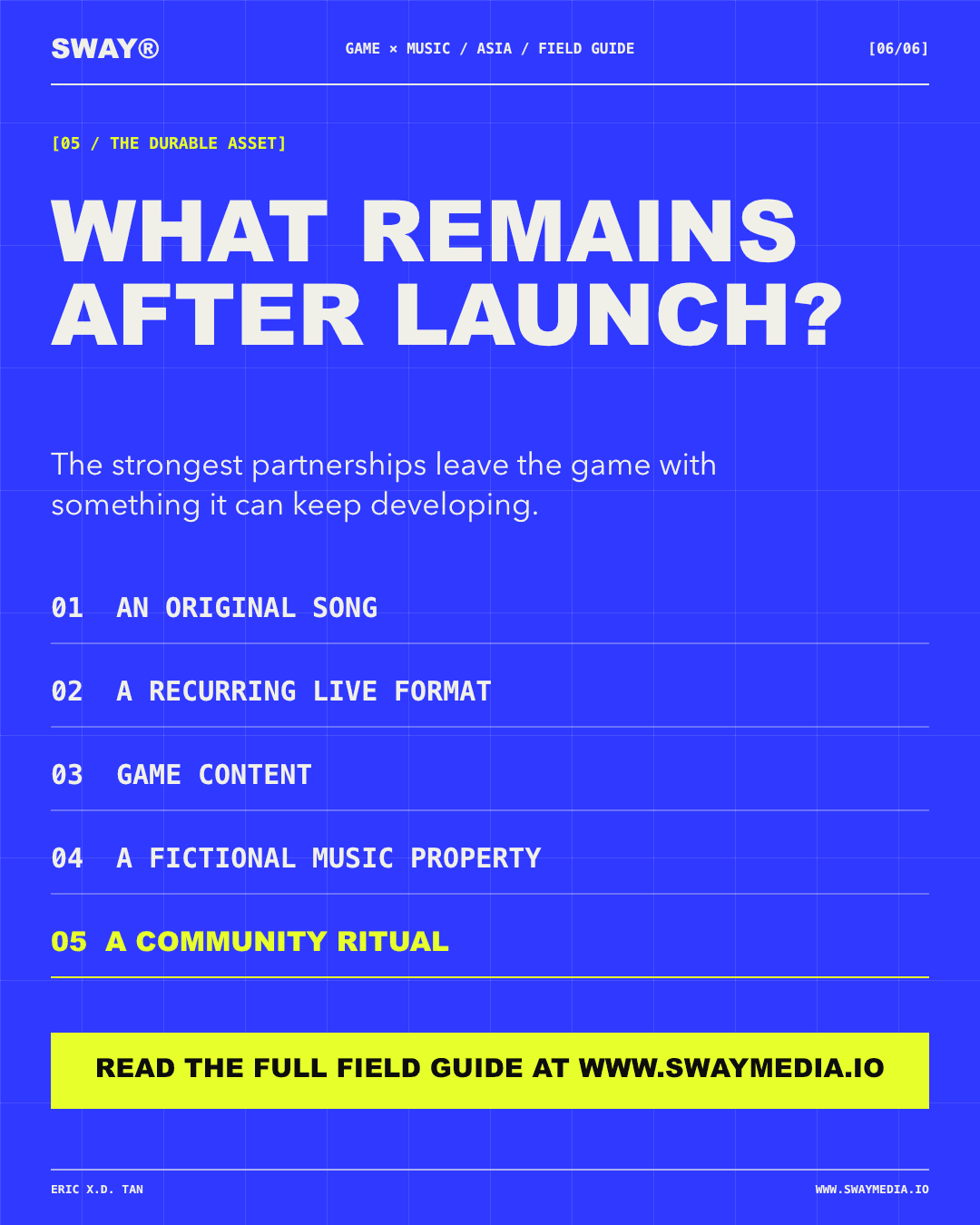
Measurement should follow the original job. Acquisition work can be assessed through qualified reach, traffic and player conversion. Community work may need participation, retention and repeat behavior. IP-building needs a longer view: streams, reuse, recall and the useful life of the asset.
What will your game still own, operate or deepen after the campaign ends?
FREQUENTLY ASKED QUESTIONS
What is a game music partnership?
It is a collaboration that uses music, an artist or a music property to perform a defined job for a game, such as player acquisition, world-building, community identity or esports participation.
How should a publisher choose an artist for Asia?
Choose the market and business objective first. Then assess audience overlap, repertoire fit, platform behavior, cultural credibility and whether the rights path can actually be executed.
Why is K-pop not a complete Asia strategy?
K-pop can be an effective choice, but Asia is not one audience. Greater China, Japan, Korea and Southeast Asian markets have distinct platforms, fandoms, languages, regulations and approval systems.
Which rights should be clarified?
Teams usually need clarity on master rights, publishing, name and likeness, game integration, live and broadcast usage, territories, term, exclusivity and creative approvals.
How should success be measured?
Measurement should follow the job. Depending on the objective, that can include awareness, player acquisition, engagement, retention, streaming, community participation and the useful life of the asset after launch.