By Eric X.D. Tan, founder of SWAY and cross-border A&R executive. Published 30 September 2026.
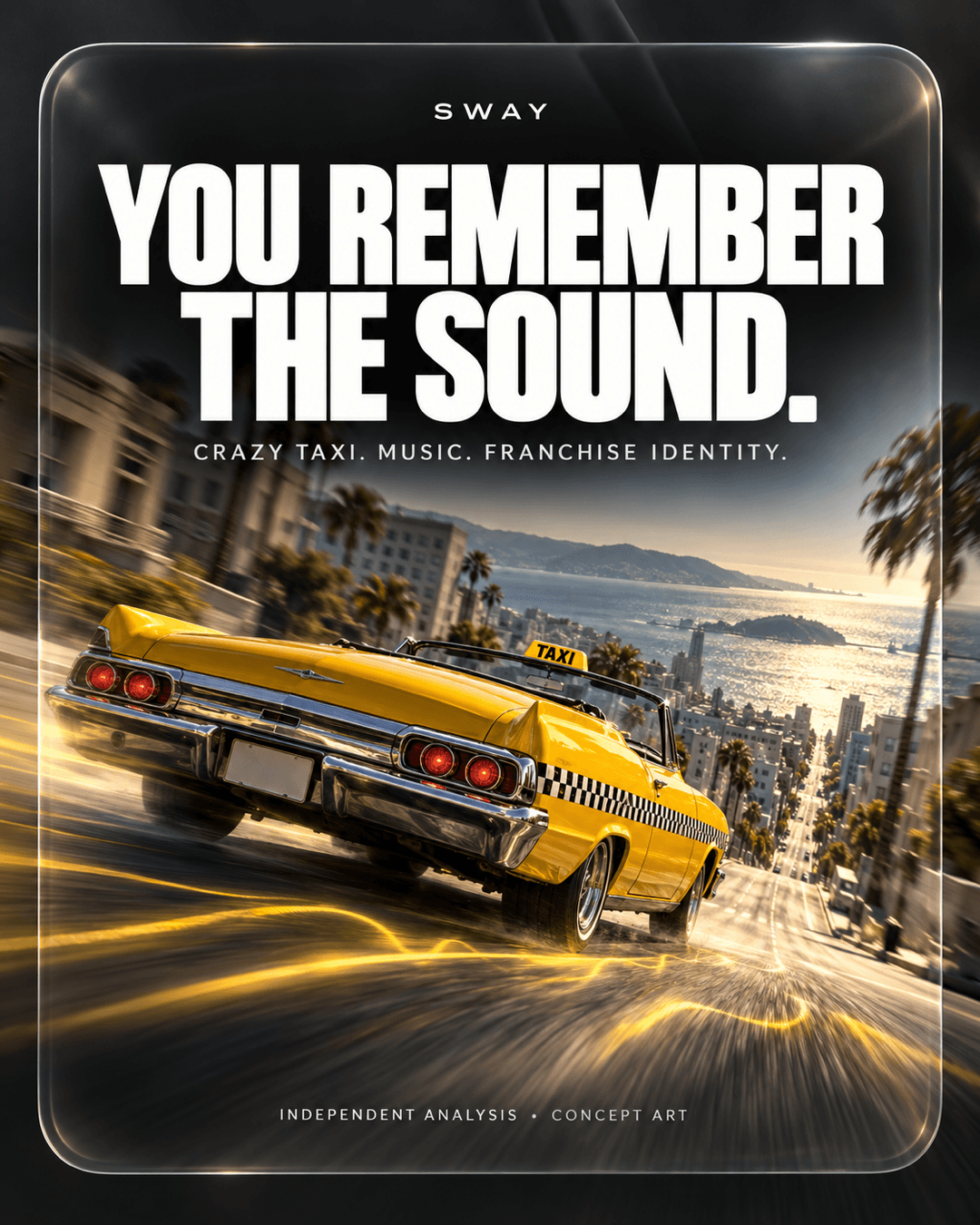
SEGA and Netflix are developing a Crazy Taxi film. SWAY's argument: adapting this franchise means understanding its musical identity, not only reproducing the yellow cab. A&R should help shape the creative brief early, connecting the attitude existing players remember with artists and songs that new audiences can make their own.
While choosing music for Crazy Taxi, creator Kenji Kanno spent a day listening to songs at Tower Records in Japan. He narrowed his choices to The Offspring and Bad Religion. He described that process in a June 2026 interview with Game Informer.
That is a revealing creative decision. A Japanese game and American punk rock found a shared language in speed, irreverence and impatience. To me, the lesson is not that every driving game needs punk. It is that a carefully chosen sound can help define what a game feels like.
WHAT HAS BEEN ANNOUNCED?
On 14 September 2026, Netflix announced a multi-title collaboration with SEGA. It includes a Crazy Taxi feature adaptation, written by Dan Gregor and Doug Mand and produced by Neal H. Moritz, Toby Ascher and Toru Nakahara. Sonic and STRANGER THAN HEAVEN projects are also in development.
Separately, SEGA has announced Crazy Taxi: World Tour for 2027. That date belongs to the game, not the film. The Netflix announcement does not specify a film release date, soundtrack or music partners.
The ideas below are independent strategy recommendations. They are not claims about an agreed SEGA, Netflix, artist or label campaign.
THE SOUND IS PART OF THE ADAPTATION.
A yellow cab is easy to recognise. Recreating an attitude is harder. Costume, dialogue, editing and music all have to support the same experience. A familiar song can recall the original without doing much for a new scene. An unfamiliar artist can feel right if the performance carries the character and energy of the world.
That makes the musical brief more demanding than a list of nostalgic tracks. The team needs to identify what should survive the change of format: urgency, humour, rough edges, perhaps the feeling of getting away with something. Then it can decide which existing songs, new recordings or original commissions express those qualities.
MAKE IT FEEL LIKE CRAZY TAXI TO SOMEONE WHO NEVER OWNED A DREAMCAST.
That is the brief I would want to answer. It leaves room for returning fans without asking a new audience to borrow somebody else's nostalgia.
FOUR DECISIONS BEFORE THE PLAYLIST.
- Define the feeling. Write a short musical brief with concrete references and a reason for each. Specify the qualities that matter, not just a genre or a famous artist. Test the shortlist against actual scenes or gameplay wherever possible.
- Give each audience a way in. Decide what an existing player should recognise and what a newcomer should discover. Ask whether a new artist contributes to the world, rather than treating follower numbers as the creative argument.
- Plan where the music needs to travel. The film, game, trailer, artist release and live performance are different uses. Bring production, label, publishing and legal teams into that conversation early. Do not assume one agreement covers every proposed use.
- Decide what happens after the first listen. Give an interested viewer a meaningful next step: a full song, an artist performance, a game experience or a community activity. Measure the action the project was built to encourage, not only the reach of the announcement.
These are planning questions, not legal advice. Rights and approvals need project-specific review by the relevant rights holders and counsel.
WHAT THIS MEANS FOR LABELS AND PUBLISHERS.
For a publisher, the useful change is timing. Bring the music discussion into the development of the adaptation's identity. Waiting until a trailer needs a track narrows the space for a genuinely connected idea.
For a label, the stronger pitch is a creative proposition. Explain why an artist belongs in this world, what they could make and how the audience relationship could continue. An available catalogue is a starting point, not the whole proposal.
Neither party should promise that a soundtrack automatically creates players, ticket sales or streams. Set an objective, identify the intended audience and build a way to evaluate the result. An original song and a catalogue placement may serve very different purposes.
THE CROSS-BORDER LESSON.
Crazy Taxi is a useful reminder that cultural fit is more specific than nationality. The publisher's home market does not, by itself, determine the right artist. The connection has to make sense within the experience and to the people the project wants to reach.
That does not make local knowledge optional. A global musical identity and a local audience plan solve different problems. For campaigns in Greater China and Southeast Asia, teams still need to understand the relevant platforms, languages, communities and partners market by market.
Our guide to game music partnerships in Asia sets out that decision process. The Jackson Wang, FIRE TO THE FUSE and XG, UNDEFEATED case studies provide context for Eric's artist-partnership work during his time at Riot Games. They are separate projects, not evidence of involvement in Crazy Taxi.
Our earlier Diablo screen-adaptation analysis considered how a show might maintain attention between game releases. Crazy Taxi raises a different question: what must an adaptation preserve for that attention to feel deserved?
Before choosing the biggest available name, ask: which artist could make this world mean something to someone encountering it for the first time?
QUESTIONS ABOUT THE CRAZY TAXI FILM.
Is Netflix making a Crazy Taxi film with SEGA?
Yes. On 14 September 2026, Netflix announced a Crazy Taxi feature adaptation as part of a collaboration with SEGA. Dan Gregor and Doug Mand are writing it. The announcement also covers Sonic and STRANGER THAN HEAVEN projects.
Is the Crazy Taxi film coming out in 2027?
The announced 2027 release window belongs to the game Crazy Taxi: World Tour. The Netflix collaboration announcement does not give the film a release date.
Are The Offspring or Bad Religion confirmed for the film?
The Netflix announcement does not identify a film soundtrack or music partners. Their association with the games should not be treated as confirmation of involvement in the film.
What does A&R contribute to a game adaptation?
A&R can help define the musical identity, select artists and repertoire, and develop a creative brief that connects the existing franchise with new audiences. This is SWAY's proposed approach, not a confirmed SEGA or Netflix plan.
SOURCES AND DISCLOSURE
- Netflix: SEGA collaboration announcement, 14 September 2026
- SEGA: Crazy Taxi: World Tour announcement, 8 June 2026
- Game Informer: Kenji Kanno interview, 12 June 2026
Independent SWAY analysis, based on the sources above and reviewed on 30 September 2026. Eric X.D. Tan and SWAY are not involved in the Crazy Taxi film or game. Artwork is an AI-assisted editorial concept, not an official poster, game screenshot or representation of the film. Referenced names and trademarks belong to their respective owners.