By Eric X.D. Tan, founder of SWAY. Published 25 October 2026.
Your China launch needs more than subtitles.
Picture a launch meeting. The Chinese translation is complete. The trailer has subtitles. The local accounts are ready. Someone says the campaign is ready for China.
Then comes the question nobody has answered: why would the intended players care?
This is an illustrative scenario, not a claim about a particular publisher. But it exposes an important distinction. Localization helps people understand a game. Cultural adaptation considers how the game, its story and its marketing fit the lives and expectations of a particular audience.
Neither replaces the other. A culturally relevant campaign cannot rescue an unusable translation. Accurate language alone does not create a community.
WHAT IS THE DIFFERENCE BETWEEN LOCALIZATION AND CULTURAL ADAPTATION?
Game localization adapts language and other product elements for a target market. Depending on the brief, that can involve text, audio, interface design and cultural references.
Cultural adaptation in marketing goes further into the audience relationship: which idea deserves attention, who can credibly introduce it, what participation looks like and what happens after the first visit.
For this guide, the distinction is practical rather than absolute. Localization teams often contribute substantial cultural expertise. The problem is a narrow brief that asks them to translate decisions already made elsewhere, without allowing those decisions to change.
START WITH A PLAYER, NOT A COUNTRY.
“Chinese gamers” is not a sufficiently precise audience brief. Start with the people most likely to value the experience, their existing interests and the alternatives competing for their time.
An audience interested in competitive mobile play may need a different invitation from someone following narrative games, virtual artists or collectible characters. Research those differences rather than assuming a single national preference.
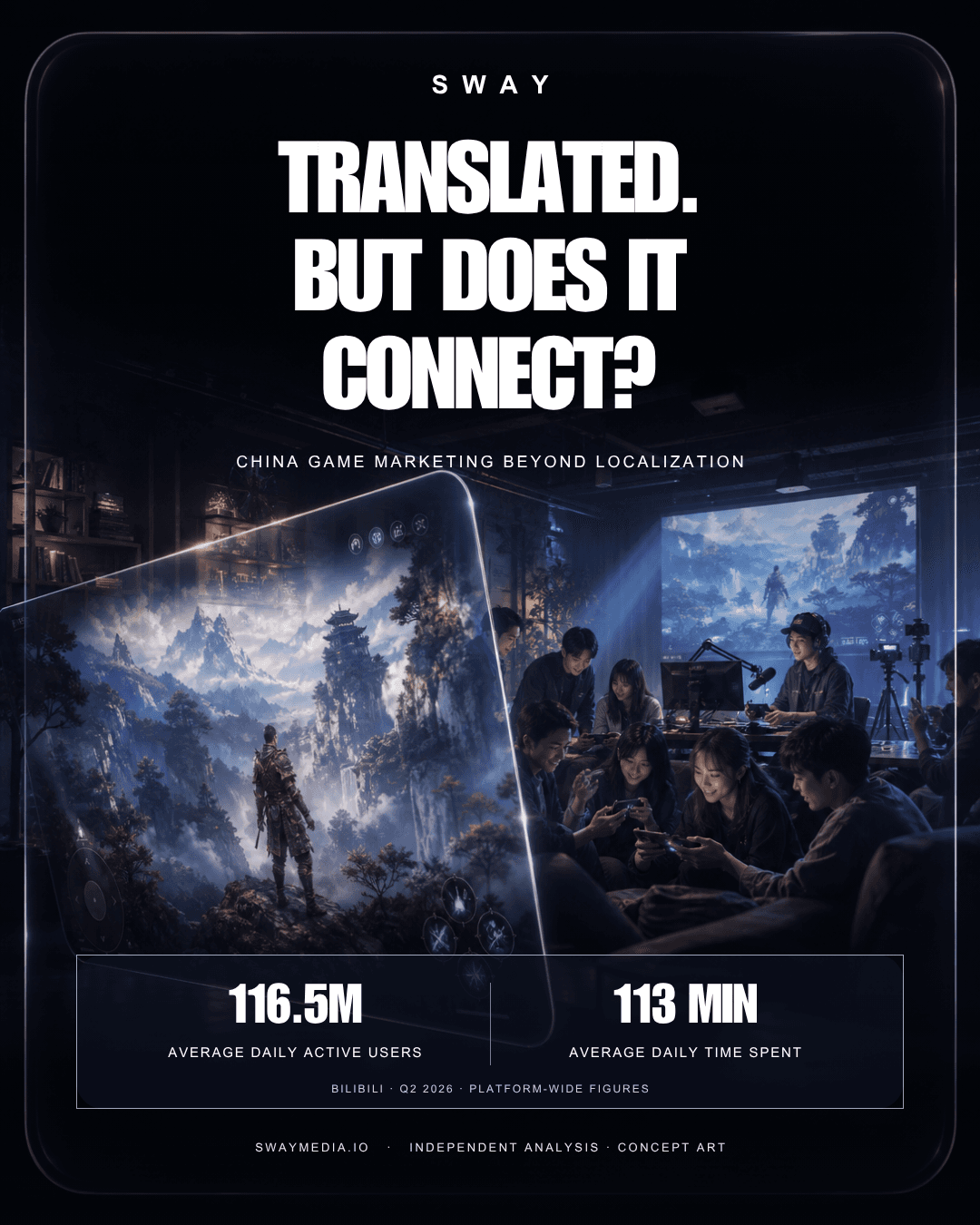
Bilibili reported 116.5 million average daily active users and 113 minutes of average daily time spent in the second quarter of 2026. These are platform-wide engagement figures. They are not counts of gamers, guaranteed campaign reach or evidence that your title belongs there.
Their useful implication is a question: what would your content contribute to the time people already choose to spend?
GIVE EACH PLATFORM A JOB.
A platform list is not a distribution strategy. Decide what each channel should accomplish before commissioning assets for it.
One brief might ask a creator to explain the game’s appeal. Another might help existing players coordinate a gathering. A third might support questions after launch. The right channel and format depend on the task and the audience, not just the largest headline user number.
Specify the next action, the team responsible for responding and the evidence that the handoff worked. A view, a qualified visit and an active community member are different outcomes.
Our Huya analysis raises a related partner-selection question: are you choosing a media channel, a publishing partner or both? Evaluate the capabilities separately. An audience does not automatically establish publishing competence.
LET CREATORS CONTRIBUTE MORE THAN REACH.
Before appointing a creator, consider audience overlap, understanding of the genre, quality of interaction and their ability to explain why the game matters.
Ask what they would change in the campaign. A creator who understands the intended players may identify an unclear promise, an unconvincing reference or a format that needs rebuilding.
Agree the scope, usage rights and approval process. Give creative freedom within a clear brief, rather than expecting a translated global script to sound like a local recommendation.
Music deserves the same scrutiny. An artist’s popularity is a starting point for research, not a substitute for audience fit, creative purpose and an executable rights path.
DESIGN SOMETHING PLAYERS CAN JOIN.
Supercell’s Brawl Stars event in Guangzhou provides a useful example. The Chinese on-site report described fans exchanging game IDs, sharing homemade support materials and meeting players and community managers.
The report also described earlier university competitions and community gatherings. That context matters: the international event was part of a longer relationship, not evidence that a community appeared because a venue was booked.
For another game, participation might mean a creator challenge, a recurring competition or a smaller gathering. The format should follow existing player behaviour and an achievable operating plan.
Do not confuse enthusiasm with a measured retention effect. An event can create a valuable experience without proving that it changed the game’s commercial performance.
MEASURE WHAT HAPPENS AFTER ATTENTION.
Choose measures that match the job. Depending on the campaign, useful evidence could include attributable visits, community participation, repeat attendance, creator contributions or player return behaviour.
Define the baseline and reporting period. Where possible, use a comparison group or another credible evaluation method. Report uncertainty when attribution is weak.
Keep marketing separate from market-access requirements. This guide is not a route to publishing approval, licensing or regulatory compliance. Those need their own qualified advice and operational work.
BEFORE YOU LAUNCH, ASK:
Who exactly is this for?
What does our campaign offer beyond a translated message?
Why are these creators and channels appropriate?
What can players participate in, and who will support it?
What evidence would tell us the approach worked?
The goal is not to make a campaign look more Chinese. It is to make the invitation more relevant to the people you want to reach.
Before your next China campaign, is your team translating the message or building a reason to belong? Explore cross-cultural audience-building with SWAY at https://www.swaymedia.io/contact.
SOURCES AND EDITORIAL NOTE
Bilibili Q2 2026 financial results, company release filed with the SEC, quarter ended 30 June 2026: https://www.sec.gov/Archives/edgar/data/1723690/000119312526371261/d434015dex991.htm
Supercell case analysis and source caveats: https://www.swaymedia.io/insights/supercell-brawl-stars-guangzhou-community-marketing
Huya case analysis and source caveats: https://www.swaymedia.io/insights/huya-livestreaming-game-publishing-china
Related SWAY guide: https://www.swaymedia.io/insights/game-music-partnerships-asia
The opening is an illustrative scenario. The recommendations are SWAY’s interpretation, not a guarantee of campaign performance. No first-hand involvement in the Supercell or Huya examples is implied.
The cover is an editorial illustration, not a photograph of an actual player event or an official game campaign.