By Eric X.D. Tan, founder of SWAY and cross-border A&R executive. Published 5 October 2026.
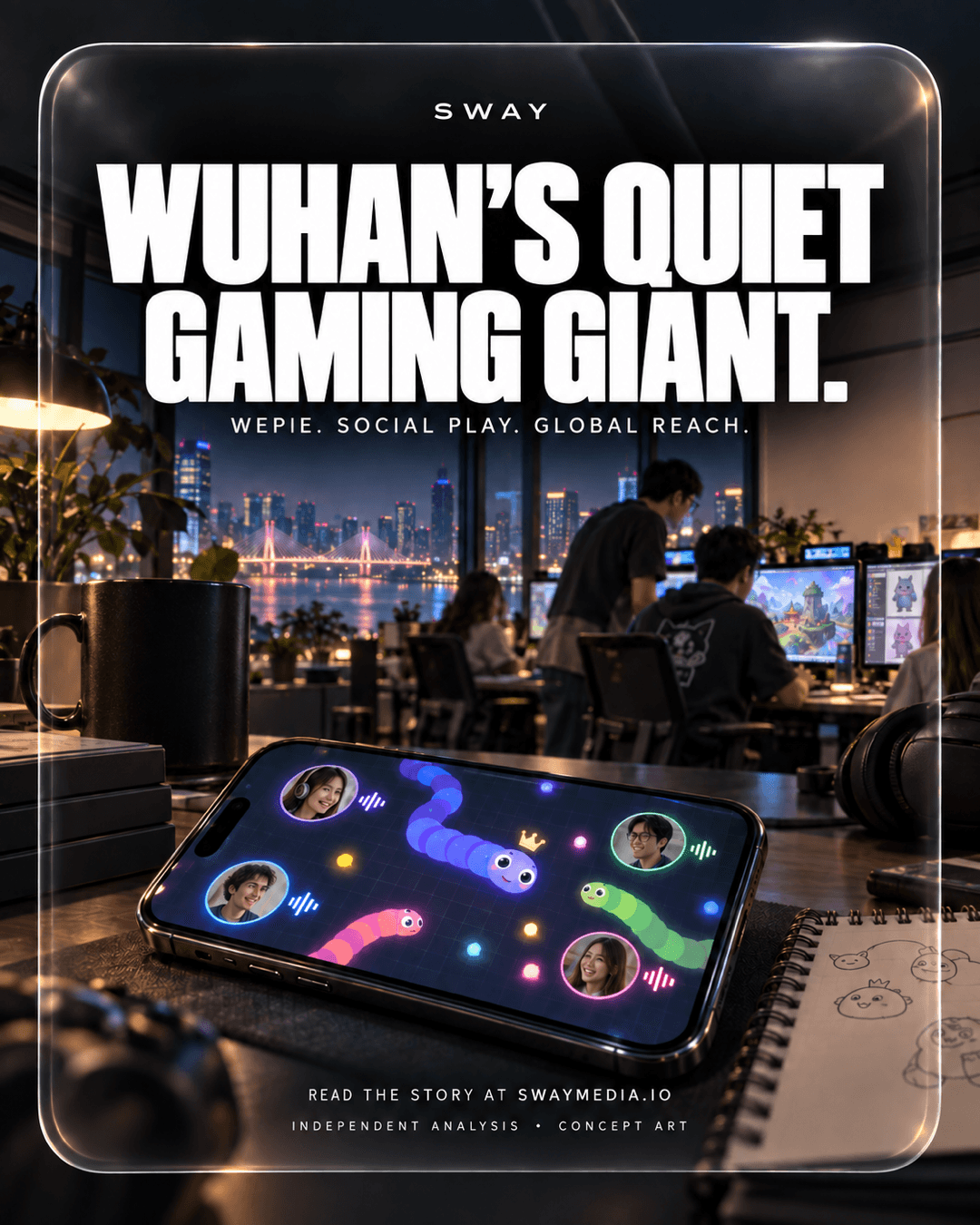
You probably missed this Chinese game company. Wuhan-based WePie built its name with a snake game, then expanded into social play. For Western game publishers, the interesting question is how a simple activity can become a reason for people to keep meeting.
Start with the snake. Move around the screen, grow longer, avoid the other players. The premise takes seconds to understand. It is easy to look at that kind of game and assume you understand the business behind it.
Then look at the rest of the portfolio. The conversation shifts from what people play to who they play with.
A COMPANY BIGGER THAN ITS BEST-KNOWN GAME.
WePie's company website says it was founded in Wuhan in August 2013 and reports more than 800 million total users across its products. That is a company-reported aggregate, not a monthly active user figure or a count of unique people currently using the apps.
Its product page dates Snake Battle, known in China as 贪吃蛇大作战, to June 2016 and reports 600 million cumulative registrations. The same page describes Huiwan as a social app built around games such as Werewolf, Who's the Spy and Draw & Guess, with live voice interaction.
Those are different reasons to open an app. One offers an immediately understandable challenge. Another gives people a setting in which to talk, compete and get to know each other.
THE NEXT GAME CAN ALSO BE THE NEXT CONVERSATION.
WePie's 2022 campus recruitment brochure identifies WePlay as Huiwan's overseas version, launched in 2021. The international Google Play listing describes casual party games and voice interaction, including social deduction, drawing and singing. It lists WEJOY Pte. Ltd. as the developer and shows more than 50 million Android downloads. Downloads are not active users or revenue.
The product proposition is worth examining. A game can make the first conversation easier. A familiar group can give someone a reason to return. Another activity can keep that group together when it wants a change of pace.
WHAT MAKES SOMEONE COME BACK AFTER THE GAME IS OVER?
That is the question I would put in front of a publishing team. It shifts attention toward the experience between sessions: invitations, room discovery, shared rituals and the people a player hopes to see again. It does not mean every game should become a social app. It means the relationship around play deserves a place in the product brief.
LOCAL RELEVANCE IS A PRODUCT DECISION.
For a voice-led experience, translation is only one part of entering a market. Teams also need to consider when people gather, how strangers become comfortable together, which activities travel and what makes a room feel welcoming. Community operations and moderation shape that experience alongside the software.
These are questions for market research and testing. The public product descriptions do not reveal WePie's acquisition costs, retention rates or margins. SWAY's interpretation is that social play offers a useful lens for understanding its portfolio, rather than treating every title as a separate download chart.
Wuhan matters to this story too. A view of China built mainly around Beijing, Shanghai, Shenzhen and the biggest publishers will miss some relevant companies. Discovery takes curiosity about products, communities and regional teams, even when their names rarely appear in the Western trade press.
WHERE MUSIC AND A&R COULD ENTER.
WePlay's singing feature raises a practical question for music partners: what would people want to do together with a song? A shared singing session, discovery moment or artist-led activity needs a clear purpose, appropriate repertoire and a rights path that fits the actual use. These are possible briefs, not announced SWAY or WePie projects.
For publishers, that means considering community behavior before commissioning a big promotional moment. For labels, it means explaining how an artist or song could support an existing habit. Our guide to game music partnerships in Asia develops that process, while our Riot Games Guangzhou analysis examines another reason to look beyond China as a launch market.
Which communities is your Asia strategy overlooking? Bring the question to SWAY, and let's turn it into a practical brief.
QUESTIONS ABOUT WEPIE AND WEPLAY.
What is WePie, the Wuhan game company?
WePie is Wuhan WePie Network Technology, a Chinese developer founded in August 2013. Its portfolio includes Snake Battle, Huiwan and social products. The company reports a total user count above 800 million across its portfolio.
What is WePlay and how is it connected to WePie?
WePlay combines casual party games with voice interaction. WePie recruitment material identifies WePlay as the overseas version of Huiwan, launched in 2021. Its international app listings identify WEJOY Pte. Ltd. as the developer.
Does WePie have 800 million active users?
The company website reports total users across its products. That is not a monthly active user count, and it should not be interpreted as 800 million unique people currently using the apps.
What can Western game publishers learn from WePie?
SWAY sees a useful product question: what makes players return to one another after the game ends? Casual play, voice interaction and local community operations can be considered together when designing social gaming experiences. This is strategic analysis, not proof of a particular retention or profit result.