The Game Studio That Turned a Banyan Tree Into an Office
Inside the Fuzhou office of the company behind Lords Mobile, a banyan tree becomes a way to explore a building.
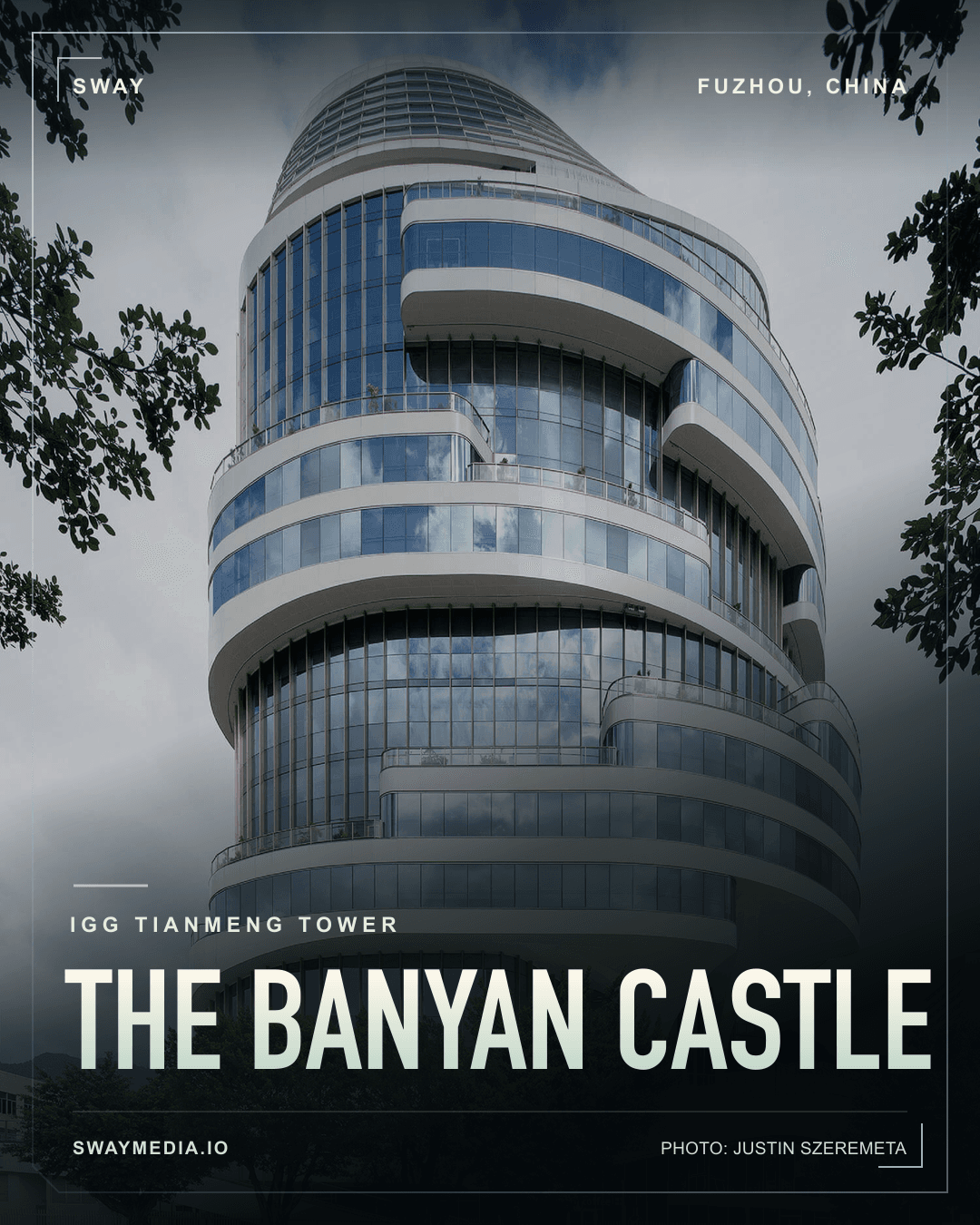
A banyan tree sends roots down from its branches. In IGG’s Fuzhou office, that idea becomes a spiralling atrium. The lift core is the trunk. Floors reach out like branches. Terraces form the canopy. It’s an 89.3-metre building, and the best way to understand its shape is to look at a tree that already belongs to the city. Woods Bagot’s project record · Contractor’s project account
What is IGG Tianmeng Tower?
Tianmeng Tower (天盟大厦) is the Fuzhou office of IGG, the Singapore-headquartered mobile game company behind Lords Mobile. Designed by Woods Bagot in Fuzhou’s Jin’an District, the building has about 50,000 square metres of floor area and opened in 2025, according to IGG. In November 2026, it earned a Highly Commended distinction in the World Architecture Festival’s Completed Buildings office category. IGG’s disclosures · IGG company profile · Woods Bagot’s award announcement
How do you design an office like a game world?
Woods Bagot calls the interior concept the Banyan Castle. You enter through a sculptural passage the designers call the Rabbit Hole. As you go up, the building reveals spaces with different purposes. There’s a children’s centre on the second floor, dining on the third, and a multimedia centre on the fourth. The main working floors are designed for everyday use, with flexible furniture and quieter colours. Woods Bagot’s interior design notes
The clever bit is what the designers do with an ordinary trip through the building. A passage makes the arrival feel like a threshold. A staircase changes what you can see as you climb. You experience the design on the way to lunch without having to know the backstory.
That’s the part I’d borrow for a game launch or a fan event. Think about what a person gets to discover by moving through the space. Will they see the whole thing from the entrance, or does taking one more turn change what they know about the world?
What do Tencent Helix and 37 Interactive do differently?
At 37 Interactive Entertainment’s Guangzhou headquarters, opened in 2024, GWP Architects turned part of the company’s logo into 7-shaped modules that shade the façade. It’s a small move with a practical job. Someone can recognise the building from the street, and the same detail helps screen the glass from direct sun. 37 Interactive’s ESG report · GWP’s design account
Tencent Helix is a much larger proposition. Büro Ole Scheeren lists 487,150 square metres of gross floor area for the Shenzhen project and expects completion in November 2028. Helix is the planned centrepiece of Tencent’s wider Penguin Island campus, where parts of the development began trial operations in 2025. Four towers are organised around a shared central space. Where IGG asks what the next turn reveals, Tencent’s architects are asking how people moving through a big campus might cross paths. Büro Ole Scheeren’s project record · Shenzhen campus update
SWAY has covered 37 Interactive’s overseas business and how Tencent gives Peacekeeper Elite players a reason to return. The question here is what happens when people encounter a game company in a physical place. IGG’s best answer is an entrance and a staircase inspired by something Fuzhou already knows.
If someone walked into a space inspired by your game, what could they discover in the first five minutes?