By Eric X.D. Tan, founder of SWAY. Published 14 October 2026.
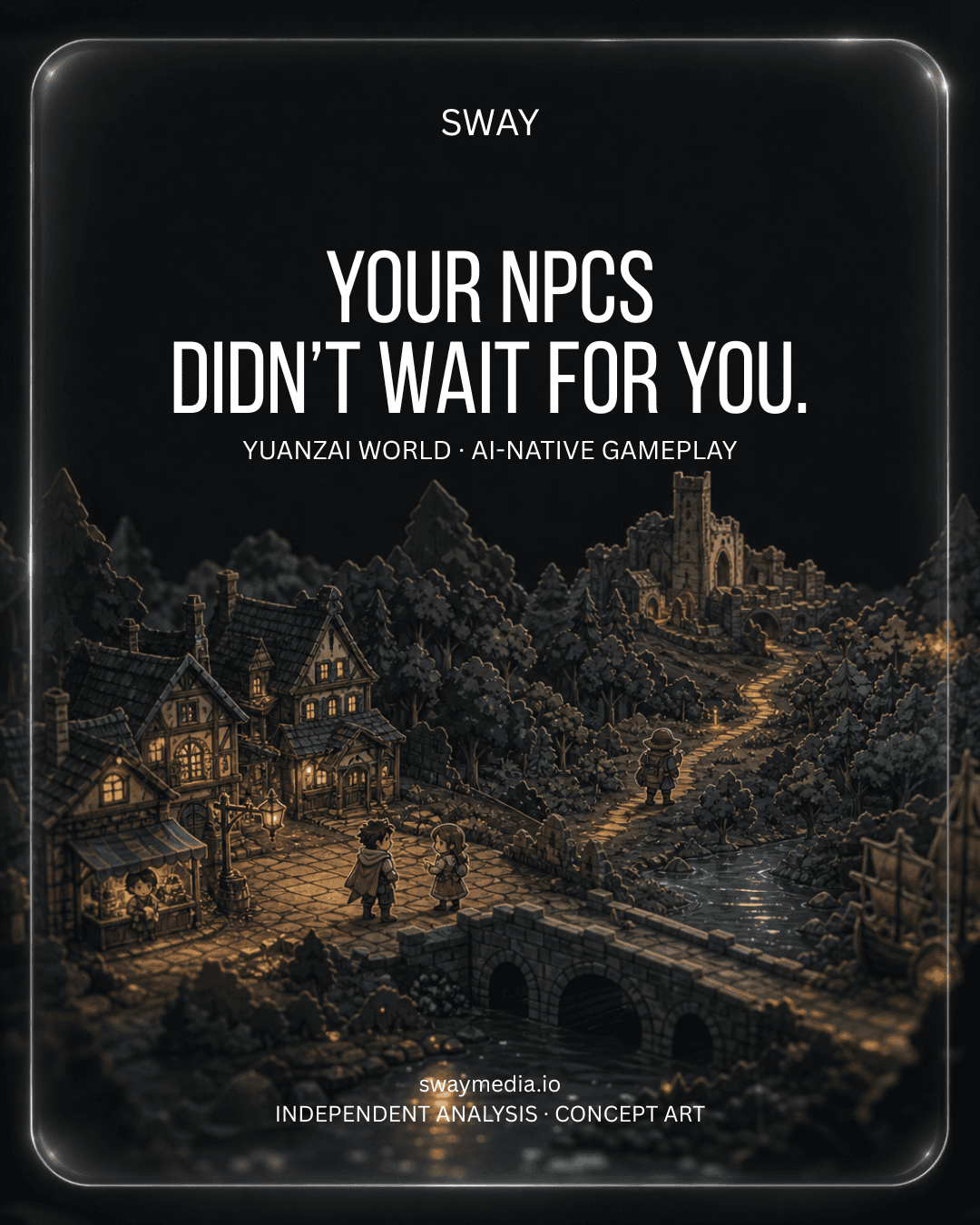
Your NPCs didn’t wait for you. You close the game for the night. When you return, two characters have fallen out. A relationship has changed. Something happened in the village without you.
That is the experience the founders of Yuanzai World, or 元仔世界, say they are building. This Chinese two-person team, Wang Kai and Chen Mingqiang, is exploring an AI-native game where characters, relationships and stories can evolve, including while the player is offline.
PLAY FIRST. THEN CREATE.
According to their interview, the product has three experience formats: an open world, text adventures and interactive stories. Think AI Dungeon with a visual world you can explore and reshape. The founders’ longer-term ambition is something closer to a lower-barrier, 2D Roblox. That is an ambition, not evidence of comparable scale.
The most interesting decision is the order. You play first. Then you create. Instead of opening an editor and wondering where to begin, you enter a world, meet a character and follow a story. Then you can change a setting, invent someone new or share your world with another player. That gives creation a reason to happen.
WHAT DOES AI CHANGE FOR THE PLAYER?
Much of the AI gaming conversation starts with production: cheaper assets, faster dialogue, smaller teams. Yuanzai asks a different question. What can AI do for the player that a conventional game cannot?
The team is starting with 2D exploration and text interaction, rather than promising a photorealistic universe. A narrower scope gives it something concrete to build and test. The founders describe character memory, evolving relationships and structured events that a game engine can execute. These are reported capabilities, not functions independently tested by SWAY.
THE HARD QUESTIONS REMAIN.
Can characters stay coherent? Do choices have lasting consequences? Will players return once the novelty fades? Can subscriptions and token charges support the cost of a continuously evolving world?
The interview does not establish those answers or provide independently verified retention and traction figures. That is why this is worth watching, not declaring the next platform winner. For publishers, the opportunity may be in experiences players want to inhabit, not simply content generated faster.
WOULD YOUR PLAYERS RETURN FOR MORE CONTENT, OR FOR A WORLD THAT REMEMBERS THEM?
Explore more SWAY analysis of Asia’s emerging gaming ideas, or discuss what they could mean for your next brief.
SOURCE AND EDITORIAL NOTE.
This article adapts the founder interview by Xia Qingyi and Lu Yifan, supported by 东西游戏组, supplied in full by the reader. Product descriptions, offline-world behaviour and platform ambitions are attributed to the founders. Strategic conclusions are SWAY’s analysis. The cover is AI-assisted independent concept art, not an official product screenshot.