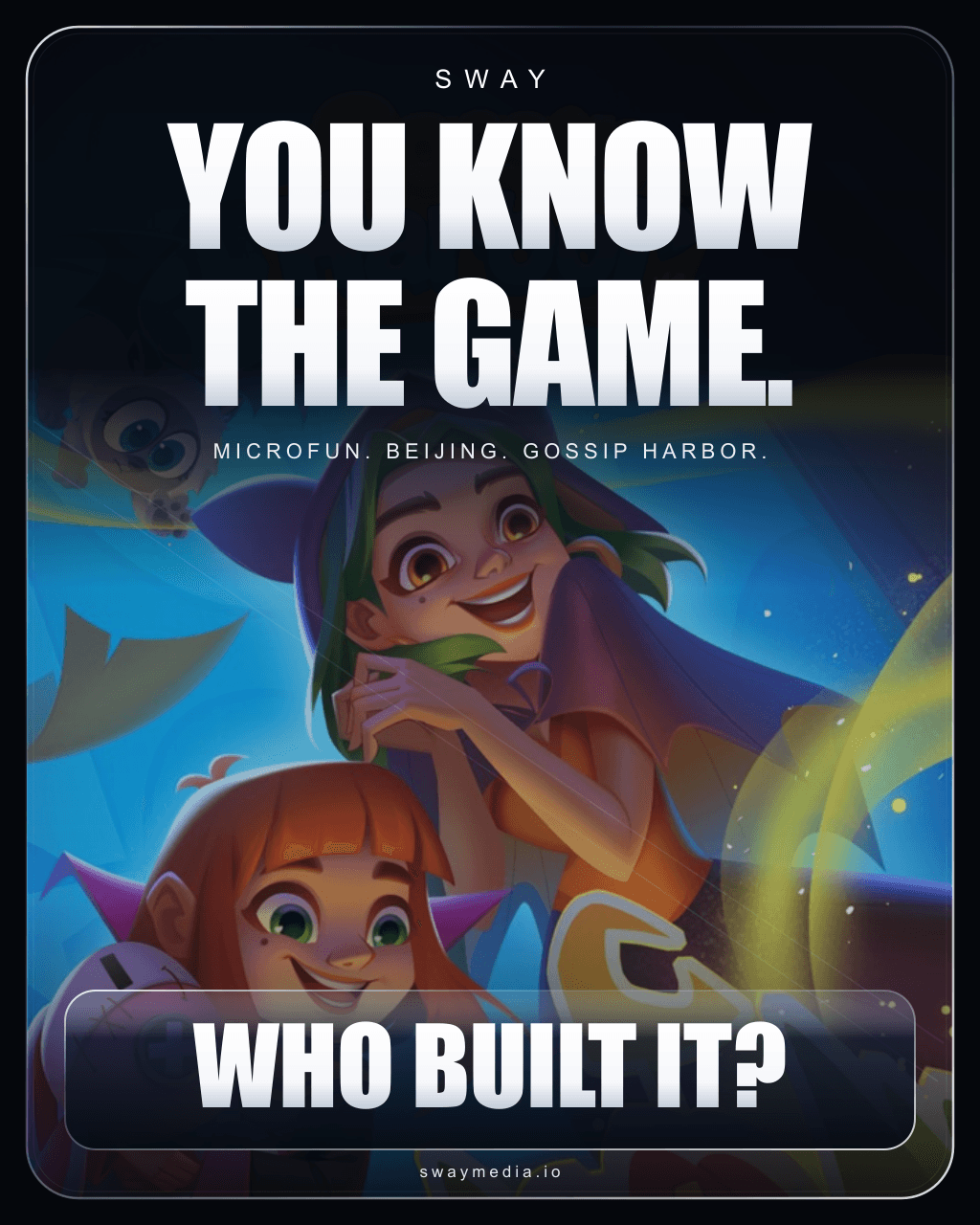
You’ve seen the ads. Meet the studio.
You’re scrolling. A restaurant needs saving. Someone has a secret. There’s another puzzle to solve.
The game is Gossip Harbor.
The company behind it is Microfun, a Beijing developer whose name may be less familiar than the characters appearing on your phone.
We mentioned it in our Chinese gaming carousel. It deserves a closer look.
Its earlier puzzle hit, Jellipop Match (宾果消消消), lists more than 300 million cumulative registrations in its Chinese App Store description. That is a historical, publisher-reported total.
For Gossip Harbor, AppMagic estimates cited by Mobilegamer.biz put September 2026 revenue at approximately US$99 million.
That estimate covers app-store in-app purchases after platform fees. It excludes advertising, web shops and China’s Android ecosystem. It tells us nothing directly about profit.
Still, there is a substantial business here.
And its appeal is easy to understand.
Serve a customer. Improve the restaurant. Discover what happens next.
The interesting work happens behind that apparent simplicity: deciding how progression, characters, events and rewards give someone a reason to return.
Microfun’s store listing promises new story chapters every Friday. The product has a publishing rhythm as well as a puzzle mechanic.
For Western publishers, brands and music partners, that creates a useful question.
How well do you understand the audience behind a game you recognise mainly from its advertising?
A soundtrack, artist collaboration or cultural partnership would need to fit that audience’s routines and emotional investment.
Celebrity alone cannot answer that brief.
Neither can a large download number.
At SWAY, I’d start with the player: what do they enjoy, when do they return, and what could a partnership add to that experience?
Visit swaymedia.io to explore our approach to music and gaming partnerships.
Which studio are you overlooking because you recognise its game before its name?
Sources and scope:
- Jellipop Match: publisher-reported historical cumulative registrations, Chinese App Store listing.
- September 2026 revenue: AppMagic estimate reported by Mobilegamer.biz. App-store IAP after platform fees; excludes advertising, web shops and China Android.
- Gossip Harbor: official App Store listing and version history.
- Microfun: official company website.